Procurement Management
We carry out global procurement activities that respect the environment and human rights"Together with our global partners, we bring innovation to everyone everywhere." This is the mission that the Socionext Group has set itself. To realize this vision and fulfill our social responsibilities as a global company, we have established rules for procurement whereby the goods and services we require are purchased from the global market at appropriate quality, price, and delivery terms in a way that is in keeping with the laws of each country and is based on fair and reasonable trading relationships.
We are also taking steps to reinforce sustainable supply chain arrangements by reducing the risks associated with societal challenges throughout our supply chain, including at our customers and partners. Along with labor, human rights, ethics, environmental, and business continuity considerations, this also includes responsible minerals procurement.
Supply Chain Management Structure
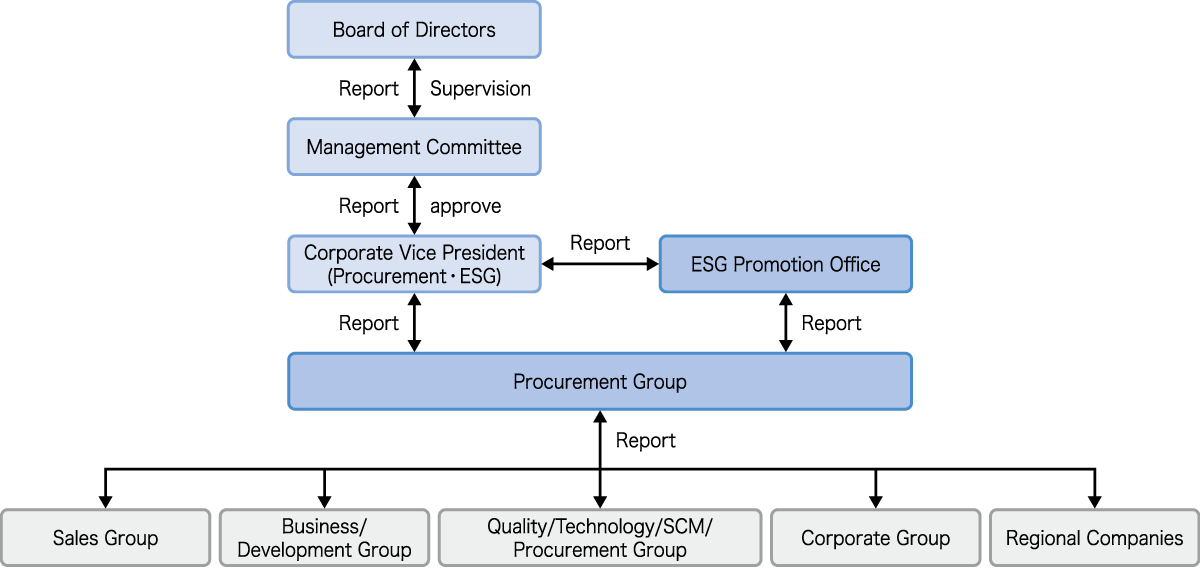
To adopt sustainability management policies and ensure the rigorous implementation of company-wide targets and the use of sustainable procurement practices throughout the group, our group works to optimize how it goes about procurement through collaboration between the departments responsible for operations and development, quality and production engineering, and corporate administration, especially in the areas of manufacturing and procurement.
We have established a system to regularly report to the Board of Directors on CSR procurement activities and Responsible Mineral Procurement activities throughout the supply chain, and under the supervision of the Board of Directors, we monitor whether sustainability activities as a whole are being implemented appropriately and provide advice and feedback to relevant departments as necessary. The Board of Directors also provides advice and feedback to relevant divisions as necessary.
●Supply Chain Management Structure Chart
Supply Chain Management
The Group believes that it is a corporate social responsibility to address social issues such as human rights, labor, the environment, and ethics throughout the entire supply chain, and has established CSR Procurement Guidelines to help our partners understand our CSR Policy and support sustainable procurement activities. These Guidelines clearly specify the items to be observed in accordance with the RBA Code of Conduct, such as "Human Rights, Labor, Environment and Ethics," and require all partners to comply. In addition, based on our CSR Procurement Guidelines, we check the compliance status of our partners every year to promote sustainability activities throughout the supply chain.
The CSR Procurement Guidelines clearly indicate the following items to be observed.
[List of items to be observed under CSR Procurement Guidelines]
| Human rights and labor | Health and safety | Environment | Fair trade ethics |
|---|---|---|---|
|
prohibition of forced labor Prohibition of child labor and consideration for young workers Consideration for working hours adequate wages and benefits Prohibition of inhumane treatment (prohibition of harassment such as power harassment and sexual harassment) prohibition of discrimination Freedom of association, right to collective bargaining |
occupational safety emergency preparedness Industrial Accidents and Diseases industrial hygiene Consideration for physically demanding work Safety measures for machinery and equipment Safety and health of facilities Health and Safety Communication health care for workers |
Environmental Permits and Reporting Reducing energy consumption and GHG emissions Emissions into the atmosphere water management Effective use of resources and waste management Chemical substance management Management of chemical substances contained in products |
Prevention of corruption and bribery Prohibition of inappropriate provision and receipt of benefits (prohibition of conflicts of interest) Appropriate information disclosure Respect for intellectual property fair conduct of business protection of informants Responsible mineral procurement Emphasizing and implementing business integrity |
| Quality and safety | Information security | Business continuity plan | Establishment of management system |
|
Ensuring product safety quality control Providing accurate product and service information |
defense against cyberattacks protection of personal information Prevention of leakage of confidential information |
BCP for natural disasters BCP for accidents and terrorism/riots BCP against the spread of disease Scope of the BCP Periodic review of manuals |
Establishment of a management system Managing Suppliers appropriate import and export controls Development of Complaint Handling Mechanism Disclosure of the status of initiatives |
●CSR survey of partners
The CSR Survey is conducted to understand the CSR risks faced by the Group's partners and to encourage them to make improvements, and we conduct supplier surveys of our partners (Manufacturing, development, jigs and tools, etc.) once a year as part of this initiative.
| Survey subject* | Response results |
Survey coverage | Major partners | ||||
|---|---|---|---|---|---|---|---|
| Number of companies | Transaction amount | Companies | Number of companies | Transaction amount | |||
| FY ended March 31, 2024 |
261 companies | 145 companies | 55.6% | 80.2% | 14 companies | 5.4% | 70.5% |
| FY ended March 31, 2025 |
97 companies | 94 companies | 45.4% | 95.1% | 14 companies | 6.8% | 67.3% |
●Survey Evaluation Items
Based on the Group's policies and the globally widely used RBA Code of Conduct, the study assesses the following categories that we consider important in transactions: "Respecting the Laws and Internationally Recognized Standards," "Human Rights/Labor," "Health and Safety," "Environment," "Fair Trade/Ethics," "Quality/Safety," "Information Security," "Business Continuity Planning," and "Establishing a Management System."
| Evaluation item | Number of questions |
|---|---|
| common | 1 |
| Respecting the Laws and Internationally Recognized Standards | 3 |
| Human Rights and Labor | 61 |
| Health and Safety | 23 |
| Environment | 18 |
| Fair Trading and Ethics | 28 |
| Quality and Safety | 11 |
| Information Security | 10 |
| Business Continuity Planning | 7 |
| Establishing a Management System | 15 |
| Total | 177 |
●Evaluation standards of Surveys
The evaluation results are classified into four stages (A to D), and if a business partner is judged to be D (high risk), the business partner is requested to correct the situation and support is provided as necessary.
| Evaluation rank | Status of Efforts | Score | Our responses |
|---|---|---|---|
| A | Very good | Overall score of 80 or above | Request cooperation to maintain the status quo. |
| B | Good | Overall score between 60 and 79 | Encouraged to further improve through continuous improvement activities. |
| C | Somewhat inadequate | Overall score between 20 and 59 | Demand improvements and cooperate as necessary. |
| D | Insufficient | Overall score below 19 | Nonconforming areas will be required to be remediated and assistance will be provided as needed. |
●Evaluation results of Surveys
The evaluation results are fed back to the partners who responded to the CSR survey, and if it is judged that there is a lack of effort in each category, the partners are informed of the issues raised and requested to make improvements by the next survey. If no correction is made, the Company will take measures such as reviewing whether to engage them in any future business.
The table below shows the evaluation results for fiscal year 2024.
| Evaluation rank | Score | FY ended March 31, 2024 | FY ended March 31, 2025 | ||||
|---|---|---|---|---|---|---|---|
| Number of companies | Ratio of companies | Ratio of response amount* | Number of companies | Ratio of companies | Ratio of response amount* | ||
| A | 80-100 | 117 | 80.7% | 99.0% | 79 | 84.0% | 97.8% |
| B | 60-79 | 22 | 15.2% | 0.9% | 12 | 12.8% | 2.0% |
| C | 20-59 | 6 | 4.1% | 0.1% | 3 | 3.2% | 0.2% |
| D | 0-19 | 0 | 0% | 0% | 0 | 0% | 0% |
| Total | 145 | 100% | 100% | 94 | 100% | 100% | |
For those partners that are rated D, corrective actions are requested with the aim of reducing ESG-related risks.
Specifically, we will promptly provide feedback to Partners who have been rated D and conduct a reinvestigation by identifying the cause and confirming the risk impact. If there is no improvement in response to the Company's request and we determine that there is a risk to business continuity, we will review the transaction with the approval of the Management Committee.
In addition, regardless of this investigation, if any incident occurs to the partner, we will confirm on a case-by-case basis whether or not the transaction can continue.
●Continued Risk Reduction Efforts
We will continue our efforts to reduce risk across partners and the entire supply chain. To check the progress of these activities, we conduct supplier surveys every year, visualize risks, and if there are high risks, conduct PDCA with partners to take corrective actions.
And the results of the annual supplier surveys are reported to the Board of Directors, which also confirms the status of risky suppliers and risk countermeasures.
| KPI | FY ended March 31, 2024 | FY ended March 31, 2025 |
|---|---|---|
| Percentage of D-rated partners who planned corrective actions. | 0% | 0% |
| Percentage of partners who planned corrective actions that improved their assessment within one year. | 0% | 0% |
●Supply Chain BCP Survey
The Group promotes proactive measures to minimize business risks for customers and the Company and to improve business continuity management capabilities in the supply chain. As part of these promotion activities, we conduct surveys on the status of our Business Continuity Plan (BCP) initiatives with our partners and feedback them. In addition, we request corrections and improvements as necessary and monitor the progress of improvements.
| FY ended March 31, 2024 | FY ended March 31, 2025 | |
|---|---|---|
| Evaluated partners | 261 Number of companies | 97 Number of companies |
| Response Obtaining Partners | 146 Number of companies | 94 Number of companies |
| Response rate | 55.9% | 96.9% |
●Information Security Survey
In the course of our development work, we sometimes receive important confidential information from our customers. Therefore, we consider information security to be an important management issue, and we are actively working on it. We conduct surveys of our partners on their progress in implementing information security measures and request them to take corrective measures and monitor their progress.
| FY ended March 31, 2024 | FY ended March 31, 2025 | |
|---|---|---|
| Evaluated partners | 261 Number of companies | 97 Number of companies |
| Response Obtaining Partners | 148 Number of companies | 94 Number of companies |
| Response rate | 56.7% | 96.9% |
Green Procurement
The Socionext Group is working to strengthen its environmental conservation efforts in cooperation with its suppliers to reduce the environmental impact of its entire supply chain. In addition to complying with environmental laws, ordinances, and international guidelines, we promote green procurement activities based on our environmental policy based on our Basic CSR Policy.
-
Reducing Environmental Impact
We aim to minimize the environmental impact of our procured products and services throughout their life cycles, from production to disposal.
-
Promoting the use of Renewable Resources
We preferentially procure products that use recycled materials and recyclable parts.
-
Improved Energy Efficiency
Select products with low energy consumption or services with high energy saving performance.
-
Reduction of Hazardous Substances
We place importance on reducing the emission of hazardous substances during the manufacturing process.
-
Sustainable Procurement
Ensure that suppliers manage resources in a sustainable manner and are committed to protecting the environment.
BCM/BCP
Acknowledging that we ourselves are part of the wider supply chain, ensuring the continuity of product supply is a core policy at our group. This means putting measures in place for business continuity and rapid recovery and acting beforehand to improve responsiveness and resilience. When an emergency does happen, we strive to fulfill our responsibilities to the community and to society and maintain continuity in the delivery of products and services to customers.
●Policy
Socionext complies with and engages in the following Basic Business Continuity Policy.
To assume various risks in ordinary times, measure against, prepare for, and consider of them, and continually improve response and restoration capabilities
To exercise responsibility in the region and society through the continuation of business in unexpected circumstances, such as large-scale disasters, and make efforts to reliably supply products and services
(Action in ordinary times)
Measures against, preparation for, and consideration of various risks in services to be restored
Determination of basic plan with clients regarding early restoration matters, such as business continuity (BC) and recovery time objective (RTO) in unexpected circumstances
Preparation of plans and other documentation, training and education for BC and recovery in unexpected circumstances
Regular evaluation of changes in the business environment and training results, and improvement of measures and procedure manuals in accordance with the results of those evaluations
(Action in unexpected circumstances)
Confirmation of safety, maintenance of safety, and prevention of secondary disasters regarding employees and their families
Implementation of necessary activities for Socionext and clients to continue business and to minimize the effects of disasters
Efforts for appropriate communication and information transmission with customers and stakeholders in times of emergency
Contributions to society, such as actively supporting local restoration and reconstruction
●Assumed Disasters
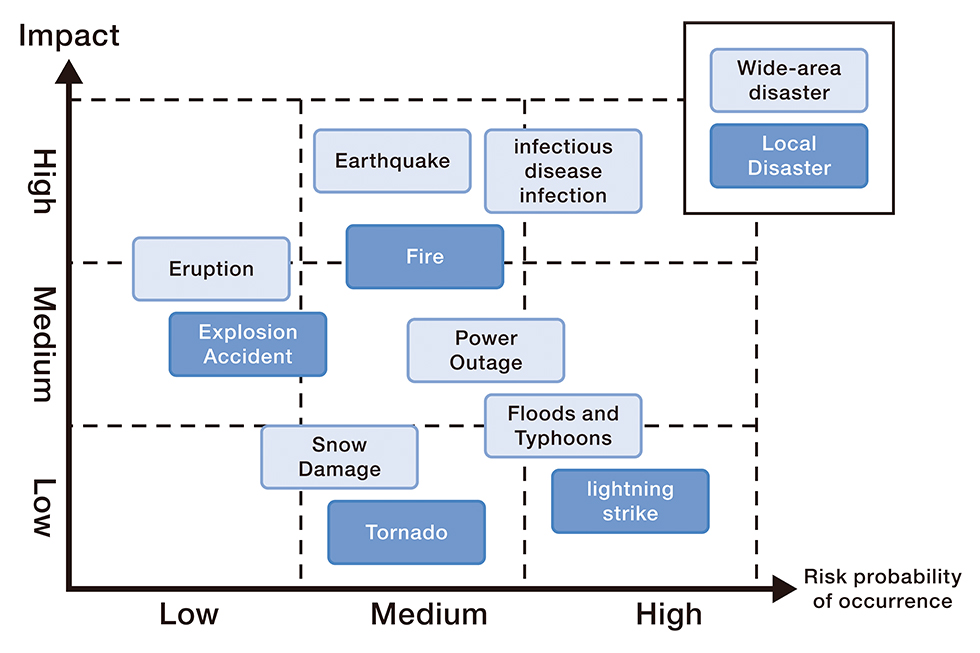
●BCP Activation Criteria (example)
Earthquake: Upper 5 on the Japanese intensity scale
Fire: Initial fire extinguishing is not possible
Power outages: Power outages in all buildings
Infectious diseases: When "WHO" declares Phase 4 or pre-alert
Common to all cases: When significant damage to management resources is expected
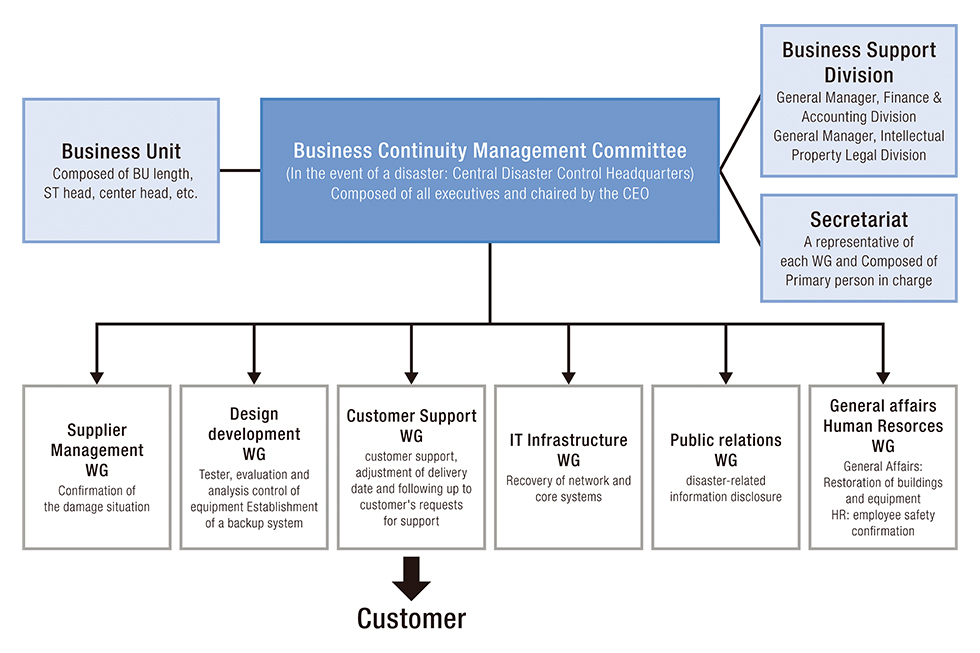
●Organization
In the event of a disaster, the disaster control headquarters (Business Continuity Management Committee in ordinary times) and six working groups will lead the initial response to the disaster and the customer Support As a company-wide approach to risk management, the Management Committee identifies, evaluates, analyzes, and checks the status about countermeasures for various risks surrounding our company throughout the year. The PDCA cycle is also carried out on a regular basis to continuously improve measures in BCP.
Rigorous Procurement Compliance
Our Group believes that it is our responsibility to fulfill our social responsibility as a global company by complying with the Basic CSR Policy and the Socionext Group CSR Procurement Guidelines.
Based on the "Basic CSR Policy" in the basic approach to compliance, Our Group has established a "Compliance Code of Conduct" to ensure that each and every employee acts with high ethical standards and compliance awareness. In it, we have made it clear that we will not tolerate bribery, cartels, or any other inappropriate methods of seeking profits, as well as insider trading, conflict-of-interest transactions, or any other unfair or opaque practices.
Through annual internal audits and other means, we confirm that business operations are conducted in accordance with basic policies, guidelines, and various regulations, and conduct periodic compliance training for all employees, not just those in the procurement department.
Fair Trading Practices
●Declaration of Partnership Building
The Group supports and participates in the goals of the Declaration of Partnership Building promoted by the Cabinet Office, Ministry of Economy, Trade and Industry, and others. Along with following good-faith trading practices with all partners, this includes commitments to co-existence and co-prosperity throughout the supply chain together with new forms of collaboration that transcend differences in company size and existing keiretsu relationships. Our goal as a group is to add value throughout the supply chain by building relationships of trust through fair and transparent trading with all our partners.
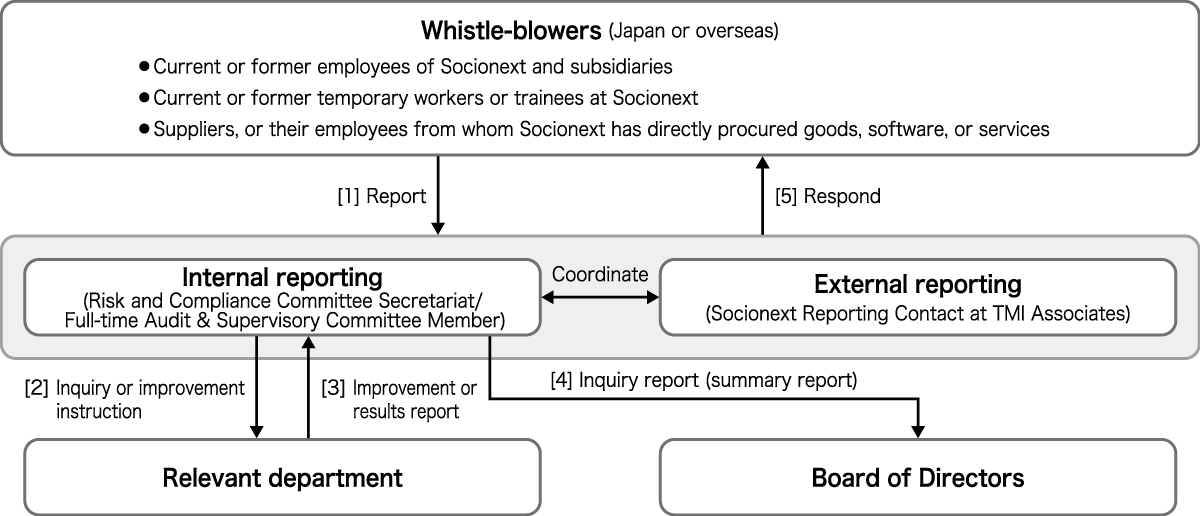
●Procurement Whistle-Blowing System
The Group reports any procurement activities that are, or are suspected of being, compliance violations and cooperates with investigations. We also respond promptly once the facts behind a report have been established and investigated. In accordance with the law and company policy on this issue, measures are in place to ensure that the persons making and receiving reports are not identified so as to prevent them from being subject to any unfavorable treatment.
[Whistle-Blowing Flowchart]